
Category: Rare Genetic and Metabolic Diseases
Objective: To describe two unrelated cases of AR- PFBC with mutations in MYORG gene.
Background: Primary Familial Brain Calcification (PFBC) is a rare neurogenetic disorder with a wide range of neuroradiological and clinical phenotypes including diverse motor, cognitive and psychiatric symptoms. Abnormal calcification could be found in basal ganglia, subcortical white matter, thalamus, and cerebellum. It’s a primary genetic disease, with identification of pathogenic variants in six genes, four autosomal dominant (PDGFB, PDGFRB, SLC20A2, XPR1) and two recessive (MYORG, JAM2).
Method: Subjects were recruited at Concepcion ‘s Regional Hospital, in Concepción, Chile. An extended neurological, family, and medical history was performed. Brain CT, endocrine study and genetic testing was performed.
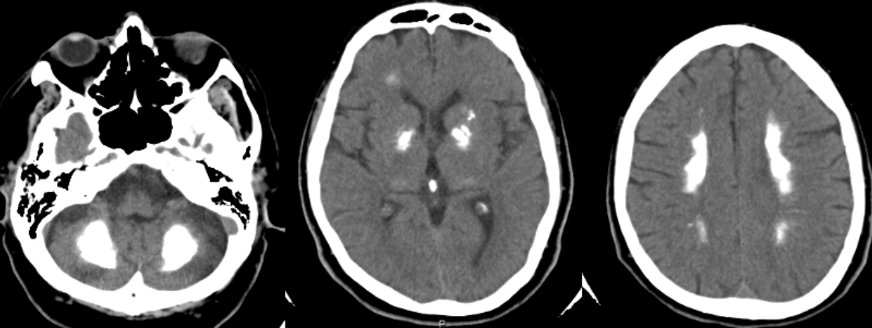
Results: Case 1: 53 years old female, presented with a history of one year of progressive dysarthria and gait instability. At examination asymmetric parkinsonism was identified. Brain CT basal revealed basal ganglia, thalamus and cerebellum bilateral calcification. The Ca/P/PTH levels were normal. A pathogenic variant in MYORG gene (p.Ile656Thr) was identified.
Case 2 62 years old male, consanguineous parents, presented with 3 years history of progressive dysarthria, parkinsonism and gait difficulties. He also presented progressive subcortical cognitive impairment and pseudo bulbar affect. Brain CT basal revealed basal ganglia, thalamus and cerebellum bilateral calcification [figure1]. The Ca/P/PTH levels were normal. A pathogenic variant in MYORG gene (p.Ile656Thr) was identified The patients reported to be unrelated. Both patients had poor levodopa response and were referred to rehabilitation therapies.
Conclusion: According to a Systematic MDSGene Review [1], PFBC due to MYORG mutations have been described in 66 patients, most of them from China. Clinical features include speech disturbances, parkinsonism with poor response to levodopa and tremor, similar to what we found in these two sporadic and unrelated cases. To our knowledge there is one report in latin America (Brasil) and this is the fisrt chilean case of PFBC-MYORG. Future studies, could asses if there is a common ancestry with the asian cases.
References: Balck, Alexander, et al. “Genotype–phenotype relations in primary familial brain calcification: systematic MDSGene review.” Movement disorders 36.11 (2021): 2468-2480.
To cite this abstract in AMA style:
E. Fernandez, P. Meza, P. Saffie. Autosomal recessive Primary Familial Brain Calcification caused by MYORG mutations. Two unrelated cases from the south of Chile [abstract]. Mov Disord. 2023; 38 (suppl 1). https://www.mdsabstracts.org/abstract/autosomal-recessive-primary-familial-brain-calcification-caused-by-myorg-mutations-two-unrelated-cases-from-the-south-of-chile/. Accessed October 18, 2026.« Back to 2023 International Congress
MDS Abstracts - https://www.mdsabstracts.org/abstract/autosomal-recessive-primary-familial-brain-calcification-caused-by-myorg-mutations-two-unrelated-cases-from-the-south-of-chile/