
Session Information
Date: Monday, June 20, 2016
Session Title: Parkinson's disease: Non-motor symptoms
Session Time: 12:30pm-2:00pm
Location: Exhibit Hall located in Hall B, Level 2
Objective: To investigate evolution of mild Parkinsonian signs (MPS) in an ongoing longitudinal study on Parkinson’s disease (PD).
Background: Mild motor impairmant may progress to PD.
Methods: Based on a population screening of 10,000 inhabitants of Luebeck/Germany aged 50-79 years and recruitment of additional PD patients, we performed two in-person examinations (n=761 and n=371 participants). In addition to a medical history, we performed a neurological examination including the full Unified Parkinson’s disease Rating Scale (UPDRS), as well as transcranial sonography (TCS) and the brief smell identification test (B-SIT). Three groups were defined: [1] Possible risk factor group (hyposmia, enlarged substantia nigra hyperechogenicity or both); [2] MPS group; [3] PD group. MPS were defined as at least one of the cardinal PD signs bradykinesia, rigidity and tremor. We studied MPS in those groups in a two-year interval.
Results: All PD diagnoses were confirmed after two years. Of the MPS group, 67% had persistent MPS. Of the "at risk" group 35% experienced onset of MPS upon follow-up. 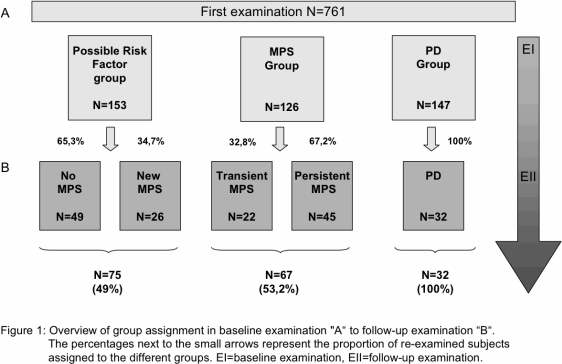
Conclusions: Although case numbers at follow-up were limited, data show that the majority of MPS persisted over a period of two years. Intriguingly, one third of participants showing one or both of the supposed risk factors for PD developed new MPS. This suggests 1) MPS could be reproduced and are relatively stable for at least two years; 2) enlarged substantia nigra hyperechogenicity and hyposmia are useful to enrich participants with new onset of MPS. However, it remains to be shown whether the observed MPS progress to PD in extended follow-ups.
To cite this abstract in AMA style:
J. Hampf, S. Tunc, J. Graf, K. Hückelheim, E.J. Vollstedt, B. Staemmler, C. Klein, M. Kasten. Evolution of mild Parkinsonian signs in a longitudinal population-based cohort [abstract]. Mov Disord. 2016; 31 (suppl 2). https://www.mdsabstracts.org/abstract/evolution-of-mild-parkinsonian-signs-in-a-longitudinal-population-based-cohort/. Accessed October 5, 2026.« Back to 2016 International Congress
MDS Abstracts - https://www.mdsabstracts.org/abstract/evolution-of-mild-parkinsonian-signs-in-a-longitudinal-population-based-cohort/